

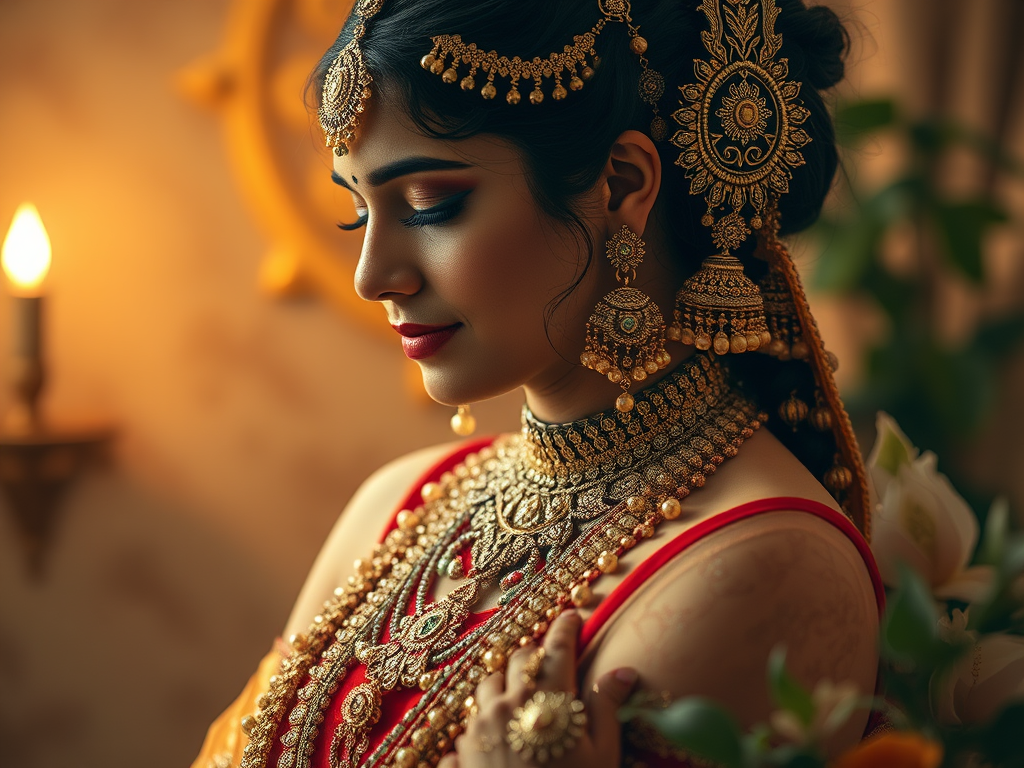

The people of India have expended limitless energy and creativity in the invention of ornaments that celebrate the human body. Adorning the visible, material body, they feel, satisfies a universal longing for the embellishment of its intangible counterpart, namely the human spirit. Indeed, rarely is a traditional Indian ornament simply decorative and devoid of inherent meaning or symbolic value.
Symbols found in Indian Jewelry act as a metaphorical language communicated from the wearer to the viewer. Such a jewelry is created from an infinite reserve of symbolically significant forms and images, some obvious, some subtle, and some whose meaning is forgotten.


Shringara of the Princess
Complementary to such thought is the conventional view where the graceful form of a woman is said to epitomize the ideal beauty and mystery inherent in nature. Thus befittingly each and every part of the feminine physique including the head, torso, limbs, and between the appended parts – have consistently been used to support ornaments, often in ingenious ways.
The Indian idea being that only things covered with ornaments are beautiful. Poetry must overflow with rhetorical ornaments (alamkara), metaphors, alliterations, and other musical effects. The verb alam-kara, “to adorn, to decorate,” means literally “to make enough” : for the simple appearance without ornament is “not enough”; it is poor, disgraceful, shocking, except in the case of an ascetic.
Hence the stress on adornment of the women, who are but the poetry of nature. Ornamentation not only serves to please the eyes of the beholder but also fulfils an auspicious purpose. The impulse to adorn stems from a deep rooted sensibility to mark every occasion of life with auspicious symbols, designs and figures to obtain good fortune and protection from evil.
Thus a fully bedecked woman evokes in the viewer a deep and ingratiating feeling of tranquil contentment, springing from an intuitive realization that evolving before him is an image of perfect beauty, symbolically conveying the richness and completeness which is but natural to nature.
The ancients who translated the abstract nuances of Indian philosophy into images of everyday reality went even further and canonized the adornment of the female form into sixteen different ornaments (solah shringar), covering her entire being from the head to toe.
The ornaments said to make up the standard repertoire of feminine adornment are:
Sindoor (Vermilion)


A Young Lady Applying Vermilion (A Sculpture Inspired by Khajuraho)

Sindoor is a deep, rich blood-red powder applied in the parting between the hair. Exclusively used by married women it represents their marital status. Significantly this same powder is an essential ingredient in Hindu rituals (puja). In relation to women the notable characteristic is the color of this powder.
A vital red it is symbolic of fertility and the regenerative power inherent in women. At a practical level (especially in India where marriages are said to be made in heaven), it proclaims in loud terms the status of a woman committed irrevocably, and as passionately as the color of her sindoor, to a single individual, and thus being out of bounds for any other.
sutra (The Marriage Thread)


Usually, a simple neck ornament worn during marriage rituals, a Mangalasutra is a sign of a married woman, who is considered “Sumangali” or auspicious by the people. Made from black beads and gold, the Managalasutra is more than just a jewellery, it is a symbol of the prosperity and bliss of a woman’s married life.
Wearing the Mangalasutra is seen as the woman’s expression of love and devotion to the husband and is believed to bring longevity and good luck to the husband. Though not as elaborate as the other jewels, the profound meaning behind the Mangalasutra makes it an unparalleled ornament and a mark of femininity.
Head Ornaments


In the ancient sculptures of women found in Hindu temples, one can observe the elaborate hairdressers and ornaments used to adorn their braids, buns, and updos. Veni, a jeweled chain worn in the braids, Chudamani, an ornament worn as a tiara or headband and Gajra, or floral bands around hair buns are some of the most popular head ornaments popular among women since ancient times.
Hair itself has been an element used in romantic poetry, where the lushness, darkness, and feel of the beloved’s hair are often mentioned in emotive language. Even in spiritual beliefs, hair and head are seen as a storehouse of one’s inner wisdom and power and proper caretaking of one’s hair is important for one’s beauty as well as for mental and spiritual well-being.
Bajuband (Worn on Arms)

Worn on arms, Bajuband is made from gold, silver, and other metals and adorned with precious gems, pearls, and other shimmering details. Different regions of India have their own designs and materials when it comes to Bajuband, for example, Tamil brides wear Vanki, an aureole-shaped armlet that has become popular today due to its unique design among lovers of jewelry, while Rajasthani brides are seen wearing Jadau or embedded Baajuband, forming a statement element in their trousseau.

Kamarband (Kati-Waist)


Katisutra or Katibandha (kati- waist) is an ancient ornament worn by men as well as women. From medieval times, this ancient jewelry became the Kamarband, an elaborate or simple ornament worn around the waist. Traditional Kamarband worn in tribal or local families have Kamarband as a part of their heirloom jewelry sets.
According to some, the more intricately made Kamadband with several chains, heavy tassels, and jewels attached to the metal, is meant to protect the womb of the woman who wears it. The beautifully made Kamarband is also meant to draw attention to the waist and hips, which are body parts associated with femininity and fertility, virtues considered sacred in Indian culture.
Toe Rings (Bichiya)

Bichiya or toe rings are an important part of the jewel chest of married women. Usually made from silver, Bichiya were traditionally made with gold and worn by women of higher caste families. A simple ring or jewel studded Bichiya is worn on the second finger of the feet, for the first time as a part of the marriage rituals.

The toe ring is also associated with health benefits, as it puts slight pressure on the second finger which is a spot linked with the reproductive system- resulting in the regulation of menstrual cycles and prime reproductive health for married women.
Payal (Anklets)


From the very first civilizations, we found traces of foot ornaments, beaded and metal anklets, also seen in the female sculptures of Hindu temples.
Anklets
Ornate anklets with large beads and jewels were worn traditionally, transforming into chic silver anklets in the contemporary time. Payal or Nupur not only forms an important part of the romantic Solah Sringaar, it is also a part of the ornamentation of Gods such as Krishna, sounds of whose anklets are immortalized in the Bhakti-poetry, describing the tinkle as a sweet melody for the devotees.
Angoothi

When Hanuman was going to Lanka with the message of Sri Rama, he had Rama’s ring or angoothi as an identification mark for Devi Sita. When she was in the ring, she immediately identified Hanuman as the messenger of her beloved Rama. In another epic story, when Dushyanta was leaving Shakuntala to go to his kingdom, he gave her his ring as a symbol of love and as an identifying mark.
Exchanged during the ceremony of ring or Sagai in modern times, rings are a recurring piece of jewelry in ancient Indian literature. Embellished with stones, jewels, and gems, rings are beyond simple piece of ornament. The type of stone or metal used in the ring holds different values in Indian culture. Gemstones studded in rings provide protection to the wearer, enhance wealth, bestow luck and bring good energies of planets (the Navagraha) to the life of the person.
Nathe (Nose Ring)

The nose was once believed to be exclusively concerned with smell, but is now established to be connected with emotional responsivity also. In fact occultists go further, believing it to be the ‘seat’ of the sixth sense. Thus the Indian aesthetic befittingly adorns the female nose with an inspired ornament, which highlights its amorous connotations.

One can imagine the ornament making a very soft, sighing sound, like breeze moving over pipal leaves, as the head moves. The length and position of nose ornaments often came in the way of comfortable eating, prompting the Abbe Dubois, a Christian missionary who lived in south India in the 19th century, to observe in amazement: “The right nostril and the division between the two nostrils are sometimes weighted with an ornament that hangs down as far as the under lip.
When the wearers are at meals, they are obliged to hold up this pendant with one hand, while feeding themselves with the other. At first this strange ornament, which varies with different castes, has a hideous effect in the eyes of Europeans, but after a time, when one becomes accustomed to it, gradually seem less unbecoming, and at last one ends by thinking it quite an ornament to the face.”
An integral part of traditional bridal jewelry, many aristocratic families have a special nath brought out at weddings to be worn by the bride. This is now perhaps the only occasion on which today’s urban woman wears the nath, evoking its powerful seductive charm.
6. Necklace (Haar)

The neck is an important occult center. Because necklaces are often worn near the heart, they can be used to work on emotions, or to attract or strengthen love. By wearing a necklace of stones for example, it is believed that we are binding ourselves with their powers. From earliest times protective pendants, necklaces and strings of beads, as well as elaborate ornamental collars, were worn around the neck to bring good luck and avert the evil eye.

Indeed, among all the kinds of jewelry, necklaces have had the maximum number of magical properties assigned to them. In some cases, they were designed as amulets or charms to insure good health or wealth to the wearer. Such necklaces could be very simple, with a gem or carving carrying the burden of the charm, or they could be very elaborate, glittering with gold and gems.
7. Karn Phool (The Ear Flower)

From earliest times long ear lobes have been regarded as a sign of spiritual development and superior status. Among the distinguishing marks of the Buddha, and a sign of his greatness, were his large ear lobes. Homer (d.c. 800 BC) and Aristotle (d. 322 BC) reputedly also had the same characteristic.
There is believed to be a close connection between the ears and the sexual reflexes. The fleshy ear lobes, absent in all other primates, are not, as they appear to be, useless appendages, but erogenous zones which in sexual excitement become swollen and hypersensitive.
In ancient times severed ears were offered to the Mother Goddess as a substitute for the male organs. In Egypt devotees offered their ears to the goddess Isis, and till the early decades of the Christian era, sculpted ears were offered at the shrine of the Great Mother in other parts of the Middle East.
The boring of ear lobes has been widely practiced in all parts of the world from early times. The purpose of this operation is not only to facilitate the wearing of earrings for beauty, but to protect the wearer from evil influences, the adornments serving as talismans. The practice was also thought to have some therapeutic value. In certain places, ear piercing was believed to be good for the eyes; it also sharpened the mind and drew off ‘bad humors’.
9. Bangles (Wrist Ornament)

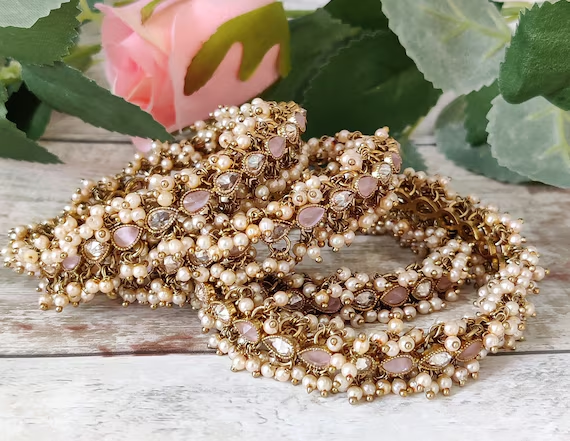
“Bangle-sellers are we who bear
Our shining loads to the temple fair.
Who will buy these delicate,
bright Rainbow-tinted circles of light?
Lustrous tokens of radiant lives
For happy daughters and happy wives.“
— Sarojini Naidu
Trying on New Bangles….
One of the oldest art objects in India, the bronze statuette of a dancing girl excavated at Mohenjo Daro epitomizes the antiquity and the universality of wrist ornaments in India. She stands in the nude with one arm at her hip, the other arm completely weighed down with a collection of bangles. From then on the variety and shape of wrist ornaments spanned the gamut of nature’ s materials and human creativity.
Indeed, more than any other single jewelry form in India, the bangle has been crafted from the widest variety of materials. Ancient fragments testify that bangles were made from terracotta, stone, shell, copper, bronze, gold, silver and almost any material that lent itself to craftsmanship.
In Conclusion
When we look at a piece of jewel, what catches the eye first is the shining gemstone or metal that makes that jewelry. However, for ancient cultures, such as India, jewelry, much like any other element of life, holds deeper spiritual meanings. Thus, the simple dot on the forehead becomes a sign of the third eye, and the designs on the palm made with henna become a sign of auspiciousness and fertility.
A walk through the symbolism behind the tradition of Solah Sringaar (16 ornamentation) bring out a romantic, delicate, and profound part of Indian culture, where the art of adornment reflects not only one’s material wealth but also inner richness.
You can buy here–
| Product | Link |
|---|
| ShopLC | https://www.shoplc.com |
| Novica | https://www.novica.com |
| Mister Spex Germany | https://www.misterspex.de |
| Bershka | https://www.bershka.com |
| Sephora | https://www.sephora.com |
| Redtag Canada | https://www.redtag.ca |
| Windsor | https://www.windsorstore.com |
The views and opinions expressed in this article are for informational purposes only and do not constitute professional advice. Jewelry, especially spiritual pieces, can have different meanings and significance for each individual. Always consult with a professional or spiritual advisor for personal guidance.
#JewelryWithMeaning #SpiritualOrnamentation #WomenAndJewelry #JewelryArt #SacredAdornments #SpiritualJewelry #MeaningfulJewelry #JewelryWithPurpose #AdornmentAndIdentity #carrerbook#Anslation#SpiritualConnection



Leave a Reply