

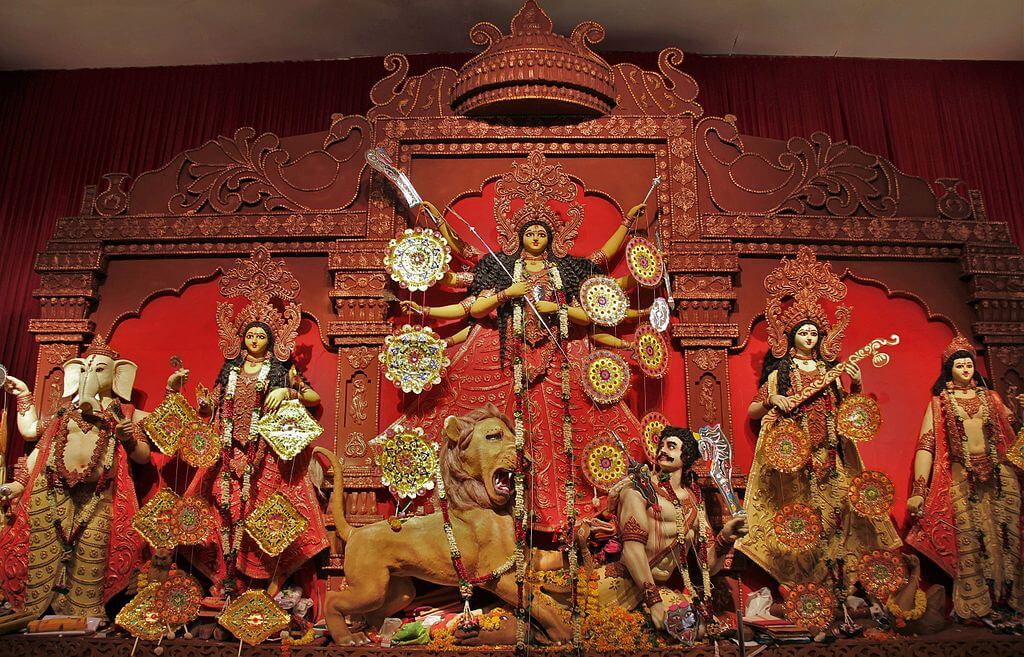

Significance of Navratri
Navratri is a vibrant and deeply rooted Hindu festival that commemorates the epic battle between Goddess Durga and the demon Mahishasura. This battle symbolizes the eternal victory of good over evil. This nine-night festival is filled with spiritual energy, cultural richness, and mythological depth. Millions of devotees across the world celebrate it as a celebration of divine power, courage, and righteousness.
Mythology: Goddess Durga vs. Mahishasura

Why we celebrate Navratri: The untold story of goddess Durga’s battle with Mahishasura
The story begins with Mahishasura, a powerful demon king. He had received a boon from Lord Brahma that no man or god could kill him. Only a woman could destroy him. Driven by this arrogance and power, Mahishasura began to terrorize the three worlds.
When the oppression became unbearable, all the gods combined their powers to create a supreme power – Goddess Durga. Each god gave her their own divine weapons – Shiva’s trident, Vishnu’s Sudarshan Chakra, and the divine weapons of other gods. Thus was born Goddess Durga, the embodiment of divine energy (Shakti).
The battle between the Goddess and Mahishasura lasted for 15 days and nights. Mahishasura repeatedly changed his form – sometimes human, sometimes animal, sometimes buffalo. Ultimately, Mother Durga killed the buffalo-like Mahishasura with her trident, establishing righteousness and balance. This victory day is called Vijayadashami or Dussehra.
Nine days and Navadurga
‘Navratri’ means nine nights. Each day a different form of Goddess Durga (Navadurga) is worshipped.
- Shailputri – Symbol of power and purity.
- Brahmacharini – Goddess of penance and knowledge.
- Chandraghanta – The epitome of courage and valor.
- Kushmanda – the creator of creation.
- Skandamata – The form of motherhood and compassion.
- Katyayani – warrior form, irrepressible courage.
- Kaalratri – The fearsome form that destroys evil.
- Mahagauri – Goddess of peace and purity.
- Siddhidatri – Giver of siddhis and blessings.
Devotees worship these nine forms and pray for power, knowledge, prosperity and protection.
Cultural color and spiritual renewal

Navratri is not just a mythological tale, but a celebration of life’s regeneration and transformation. Celebrated with great enthusiasm in India and Nepal, it also marks the change of seasons (from rainy season to autumn).
While Gujarat’s nights are filled with colorful garba and dandiya, West Bengal’s Durga Puja is a sight to behold. Fasting, prayer, dance, and music add to the joy of the festival. Fasting is not just a tradition, but a means of purifying the body and mind.
The message of Navratri in today’s times
The story of Goddess Durga and Mahishasura remains relevant to life even today. It teaches that courage and integrity can conquer even the greatest evils. Navratri is a celebration of feminine power and divine energy – the power that nurtures, protects, and transforms.
This festival inspires us to recognize our inner strength, break free from negativity, and live a life of morality. This is why Navratri is not just a religious festival, but a celebration of life itself – symbolizing the triumph of light over darkness.
#Navratri2025 #WhyWeCelebrateNavratri #MaaDurga #MahishasuraMardini#Carrerbook#Anslation #NineNightsFestival #GoodOverEvil #Shakti #NavDurga #Vijayadashami #DurgaPuja #GarbaNights #DandiyaRaas #SpiritualJourney #FestiveIndia #IndianCulture



Leave a Reply