

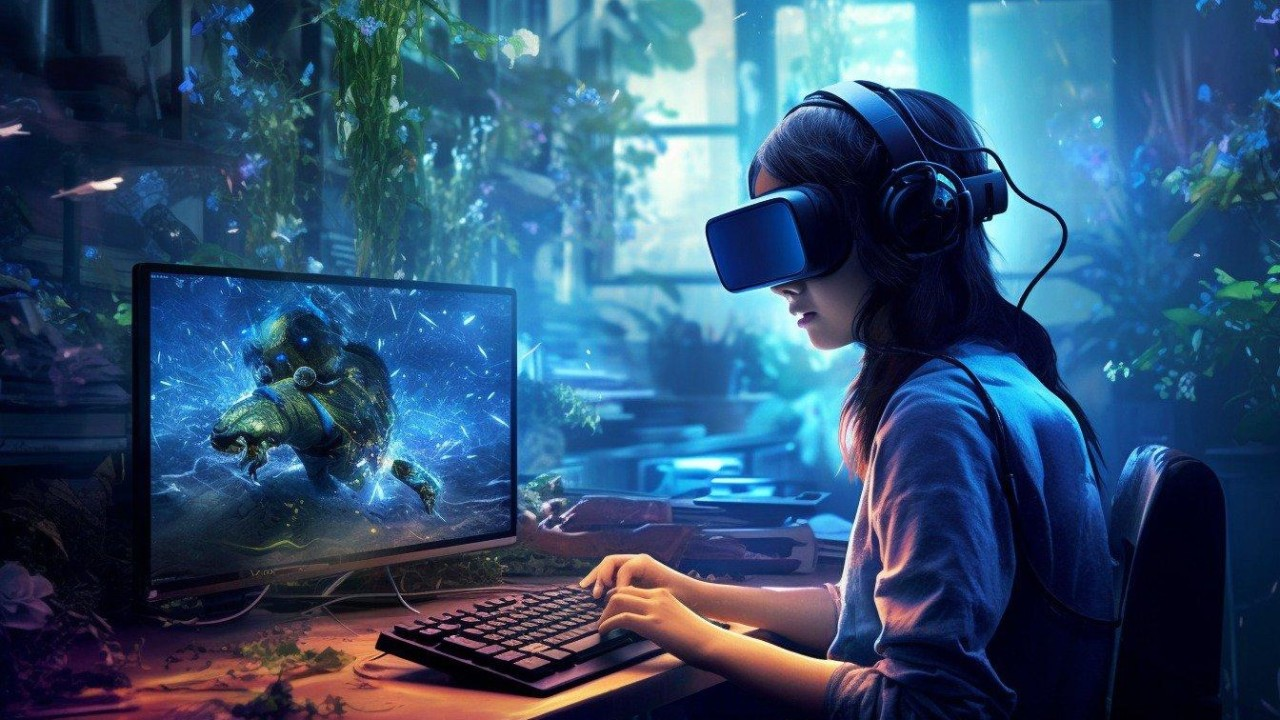

The role of artificial intelligence in video games is quietly undergoing its most significant evolution in decades.For the longest time, “game AI” wasn’t actually artificial intelligence in the modern sense. It was a collection of clever logic scripts, decision trees, and state machines designed to give the illusion of intelligence. An enemy guard knew to run toward a alarm button if you broke line-of-sight, a boss had clear phase transitions at 50% health, and racing opponents stuck to ideal driving lines like train cars on invisible tracks.
Today, that boundary is dissolving. AI is transitioning from a set of rigid background rules into a flexible, active partner across the entire gaming pipeline—reshaping how studios build worlds, how non-player characters (NPCs) talk to us, and how games adapt to our individual playstyles.
Beyond Fixed Scripts: AI Smarter, Reactive NPCs

The most visible shift is happening in non-player characters. Traditional NPCs are functionally vending machines: you walk up, press a button, and receive one of five pre-recorded lines or a static quest prompt.
Modern AI systems allow NPCs to act more like actors with a general prompt rather than actors reading a strict script.
- Dynamic Memory & Context: Instead of resetting every time you re-enter a town, NPCs can retain behavioral state. If you steal from a shopkeeper early in the game, that action can subtly color how their family members treat you hours later, without a designer having to manually program every specific permutation.
- Unscripted Dialogue Systems: By combining large language models (LLMs) with strict boundary parameters, developers are experimenting with characters that can converse fluidly. You can ask an NPC about local rumors in your own words, and they can synthesize an in-universe answer based on the world’s lore without breaking immersion.
The Design Challenge: Unchecked freedom ruins storytelling. If a key quest-giver generates a random response that contradicts the main plot, the narrative falls apart. Developers are focusing heavily on “guardrail architecture”—giving AI characters personality and leeway while keeping them firmly anchored to the game’s core script and tone.
Dynamic World-Building & AI-Assisted Procedural Generation

Procedural generation has been around since Rogue and Elite in the 1980s, but classical algorithms rely on mathematical formulas that often produce repetitive, soulless environments. AI-driven content generation works differently.
+-----------------------------------------------------------------------+| CONTENT GENERATION EVOLUTION || || [Classic Procedural Logic] ---> Seed-Based Math ---> Repetitive Grids || || [AI-Assisted Generation] ---> Neural Pattern ---> Context-Aware || Recognition Environments |+-----------------------------------------------------------------------+
Rather than just randomly arranging pre-made room blocks, generative AI tools analyze structural patterns. They can layout realistic terrain erosion, place foliage where sunlight and water would naturally allow it to grow, or generate realistic interior layouts for hundreds of unique, explorable buildings in an open-world city.
Crucially, this isn’t replacing level designers—it’s eliminating the tedious manual labor. An artist can block out the grand vision of a mountain pass, and AI tools can fill in the granular rock textures, gravel distributions, and background foliage in seconds, leaving the artist to fine-tune the lighting and emotional beats of the scene.
Truly Adaptive Difficulty and Player Personalization

Traditionally, choosing a difficulty setting meant picking between static multipliers:
- Easy: Enemies have $50\%$ health and deal minimal damage.
- Hard: Enemies have $200\%$ health, pinpoint accuracy, and aggressive reaction times.
This binary approach often feels artificial. Dynamic Difficulty Adjustment (DDA) powered by machine learning analyzes player behavior in real time to tune the experience far more subtly.
If a system detects you are consistently mastering parry timings, it won’t just arbitrarily inflate enemy health bars. Instead, it might instruct enemy AI to mix up their attack rhythms, flank your position, or coordinate group attacks. Conversely, if you’re stuck on a platforming section for an hour, the game might subtly adjust jump tolerances or tweak camera angles to help you clear the gap—keeping you in a state of “flow” without making you feel patronized.
Behind the Scenes: How AI Is Changing Game Development

The most dramatic changes brought by AI aren’t happening on your screen; they’re happening inside development studios. Building a modern AAA game routinely takes 5 to 7 years and hundreds of millions of dollars. AI tools are helping streamline that workflow:
Automated QA and Stress Testing
Finding bugs in an open-world game with millions of interaction variables is a nightmare for human testers. Developers now deploy thousands of automated “AI bots” that play the game at super-human speeds—running into every wall, casting every spell combination simultaneously, and trying every menu action to spot crash bugs, memory leaks, and map breaks long before human QA teams do their targeted playtesting.
Rapid Prototyping
Testing a new game-play mechanic used to require weeks of coding and gray-box modeling. With AI-assisted coding tools and asset generation, a small team can build a playable, rough proof-of-concept over a weekend, decide if the core game-play loop is actually fun, and iterate immediately.
The Real-World Challenges and Risks

Despite the hype, integrating AI into games comes with significant technical and ethical friction points:
- The Loss of Authorial Intent: Hand-crafted design is what makes games like Dark Souls or The Legend of Zelda legendary. Every enemy placement, health potion, and sightline is intentional. Over-relying on generative AI risks creating vast, empty worlds that feel mathematically impressive but emotionally hollow.
- Voice Acting and Creative Ethics: The use of generative voice models and AI art assets has sparked intense debate regarding copyright, consent, and the protection of human voice actors and artists. Responsible studios are navigating how to use AI as an efficiency tool without replacing the human talent that gives games their soul.
- Predictability vs. Mastery: If an enemy AI adapts too perfectly to your playstyle, it can break the satisfaction of learning a game’s systems. Winning feels rewarding because you figured out a pattern; if the pattern changes endlessly, game-play can feel arbitrary and frustrating.
What the Future Actually Looks Like

We aren’t heading toward a future where a single prompt generates a masterpiece video game at the press of a button. Game design is far too complex, requiring a delicate blend of pacing, emotional resonance, mechanical depth, and artistic vision.
Instead, artificial intelligence will act as an invisible force multiplier. It will handle the invisible grunt work—automating bug testing, generating realistic background terrain, and giving side characters just enough intelligence to make virtual worlds feel alive. The best games of the next decade won’t be “made by AI”—they will be crafted by human creators who use AI to build worlds bigger, deeper, and more reactive than anything we’ve played before.
FAQs
1. How is AI changing the gaming industry?
AI is changing gaming by helping developers create smarter NPCs, more responsive game worlds, personalized experiences, automated testing, and new approaches to game development.
2. How is AI used in video games?
AI can control enemy behavior, improve NPC interactions, adjust difficulty, personalize game-play, support procedural content generation, and help developers test and optimize games.
3. Will AI make NPCs more realistic?
Potentially, yes. AI can allow NPCs to respond more dynamically to player actions instead of relying entirely on fixed dialogue and scripted behaviors.
4. Can AI create entire video games?
AI can assist with parts of game development, including brainstorming, prototyping, coding assistance, testing, and content creation. However, creating a polished game still requires human direction, design, development, and quality control.
5. Will AI replace game developers?
AI is more likely to become a development tool than completely replace game developers. Human creativity, game design, storytelling, technical judgment, and artistic direction remain important to creating a successful game.



Leave a Reply