

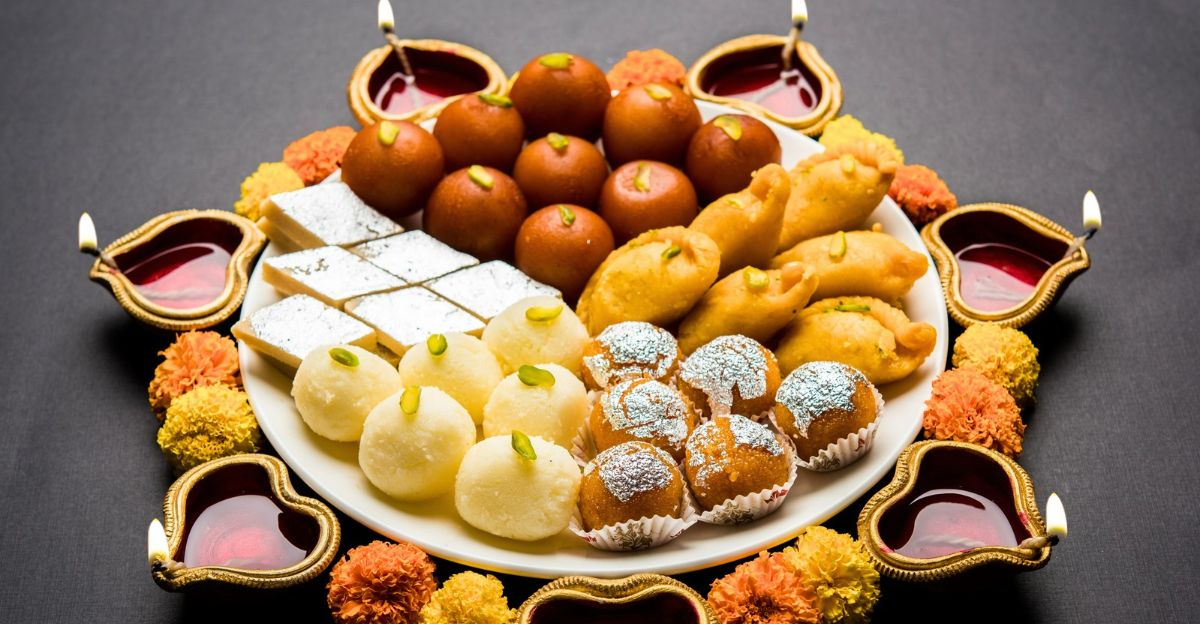

My mother has a rule that the kitchen belongs to her from the Monday before Diwali. Nobody argues. You can ask for tea, you can carry a tray, you can wash a pot if she points at it, but you do not touch the stove unless she’s looking. I used to find this annoying. Now I think it’s the most Diwali thing about my house. The smell starts first: besan roasting in ghee, slowly, so slowly that you start wondering if she forgot it. Then mustard seeds popping somewhere. Then someone “tasting” a ladoo that isn’t cooled yet and burning their tongue, which is usually my brother, and he does it every single year.
I’m not a natural cook. My first ladoos could have been used as cricket balls. My first gulab jamuns dissolved. But I’ve been hanging around that kitchen for a long time, and I’ve picked up enough to share. Dhanteras is tomorrow, and Diwali is on Sunday, so if you’re still deciding what to make, here’s what I’d make. Four sweets, three namkeen, and a few things I learned by getting them wrong.
Why I’m cooking more this year

Something I read made me want to cook more at home this time. The food safety authority, FSSAI, sent a directive on 29 September asking states to step up inspections and sampling during Navratri and Diwali. The list included milk products, ghee, khoa, paneer, sweets, namkeen, and papad on Diwali.
I don’t think every mithai shop is cheating. Our neighbourhood one has been honest for as long as I can remember. But I read that news, and then I looked at the box of sweets my aunt had sent, and I thought: I’d like to know what’s in what we put in front of the puja. Homemade also means I can use less sugar, and nobody asks me for rose-coloured barfi on Diwali.
If you do buy from a shop, go to a licensed one, and pick freshly made things over anything that’s been sitting around in a gift box.
Besan ladoo, and why you can’t hurry it

I’ll start here because it’s the one that taught me patience, and I’m still not great at it.
You need besan for Diwali recipe , about two cups. Ghee, three-quarters of a cup, a bit more if your besan is thirsty. Powdered sugar, three-quarters of a cup. A pinch of cardamom, and chopped nuts if you like them.
The whole thing is the roasting. Ghee in a heavy pan, low flame, besan in, and then you stir. And stir. At first it looks like wet sand. After ten minutes or so it loosens and starts smelling nutty, and after fifteen or twenty it goes golden and the whole kitchen smells like a festival. If it smells raw, it’s not done. I once stopped too early and the ladoos tasted like uncooked chapati, which my brother ate anyway.
Then comes the part I always get wrong. Let it cool for about ten minutes before adding the sugar. If it’s too hot, the sugar melts and you get a sticky mess that won’t hold a shape. Mix in the sugar, cardamom, and nuts, then shape the ladoos while the mixture is still warm. If it crumbles, a spoon of warm ghee fixes it. They keep a week or two in a box, though mine rarely last that long.
Kaju katli looks harder than it is


Everyone is scared of kaju katli on Diwali, and I get it. It looks like something a professional makes. But it’s really just cashews, sugar, and a bit of attention.
Grind a cup of cashews to a fine powder, but do it in short bursts. If you run the grinder continuously, the cashews release oil and you get a paste, which I’ve done and cried about. Sieve it if you can be bothered.
Boil half a cup of sugar with a quarter cup of water until it’s just sticky. To check, touch a drop between your thumb and finger and pull them apart. You want one thin thread, no more. Tip in the cashew powder and a pinch of cardamom, and stir on low heat for about five minutes until it pulls together and leaves the sides of the pan.
Be careful here, because hot sugar sticks and burns. Tip it on a greased plate, let it cool a little, knead it with a bit of ghee, and roll it between two sheets of butter paper, quite thin. Cut diamonds when it cools. My first batch was too hard because I overcooked the syrup. If yours turns dry, a spoon of warm milk or ghee saves it.
Gulab jamun (my long, embarrassing history)

I’ve failed at gulab jamun more than anything else in my life, including my driving test. Some came out hard as pebbles. Some split open in the oil and made a horrible mess. My mother would look at them and say nothing, which was worse than criticism.
The version that finally worked for me uses milk powder. Mix a cup of milk powder with a quarter cup of maida and a pinch of baking soda (a quarter teaspoon, no more). Rub in two tablespoons of ghee, then add milk, a spoon at a time, until you have a soft dough. Don’t knead it like roti dough. Handle it gently, almost lazily. If you work it too hard, the jamuns turn tough.
Roll small, smooth balls. Any cracks will open in the oil, so smooth them out. Fry in ghee or oil on the lowest flame you’ve got, turning them constantly until they’re deep golden. If the flame is too high, they brown outside and stay raw in the middle, and nobody wants that.
For the syrup, boil a cup and a half of sugar with the same amount of water, a couple of cardamom pods, and a few drops of rose water. It should be sticky, not thick. Drop the hot jamuns into warm syrup and leave them for at least an hour. Fry one test jamun first. If it breaks, add a little more maida to the dough. If it’s hard, use a bit more milk next time.
Kheer for the Diwali puja
Kheer is simple, and I like that it’s one dish where I don’t have to pretend to be fancy. A third of a cup of rice, washed and soaked for twenty minutes. A litre of full-fat milk, brought to a boil in a heavy pot. Add the rice, turn the flame down, and keep stirring, because milk is sneaky and will catch the bottom if you look away.
It takes about forty or fifty minutes for the rice to go soft and the milk to thicken. Then sugar (half a cup, but taste it), crushed cardamom, saffron if you have it, and chopped nuts. It thickens as it cools, so a splash of milk loosens it up. In our house, it goes to the deity first, and then to the rest of us.
Now the salty stuff recipe in Diwali: poha chivda

After enough Diwali sweets, my tongue starts begging for salt. This is where namkeen comes in, and poha chivda is the easiest place to start, so if you’ve never made namkeen, begin here.
The secret is to dry roast the poha first.
Take about Diwali recipe four cups of thin poha and roast it in a wide pan, in small batches, on low flame for five to seven minutes, stirring all the time. It should turn light and crisp, and snap when you break it, without going brown. I skipped this once and the chivda was soft by the next morning. Never again.
Then in a little oil (about two tablespoons) fry half a cup of peanuts until they crackle, then a handful of cashews, and a couple of spoons of roasted chana dal. Add a teaspoon of mustard seeds, ten or twelve curry leaves (they splutter, so stand back), and two slit green chillies. Stir in half a teaspoon each of turmeric and red chilli powder, then tip in the poha, a teaspoon of sugar, and salt. Toss gently for two or three minutes.
Let it cool completely before it goes into a tin. It stays crisp for around two weeks. If anyone in your house is allergic to peanuts, make a separate batch.
Besan sev recipe on Diwali, for people who want a small challenge


Sev needs a press, the kind with a plate full of tiny holes. If you don’t own one, borrow it from your aunt like I did, and expect a lecture about returning it.
For the dough, mix a cup of besan with a couple of tablespoons of rice flour if you want it extra crisp. Add half a teaspoon of ajwain, half a teaspoon of red chilli powder, a pinch of turmeric, and salt. Pour in a spoon of hot oil and rub it through. Add water slowly and knead to a smooth, softish dough, softer than chapati dough but not sticky.
Heat the frying oil on medium. Grease the press, fill it with dough, and press circles straight into the oil. Fry for two or three minutes, until the bubbling calms down and the sev turns pale gold. Drain it, cool it, and break it up.
A safety note, because hot oil is no joke. Don’t hold the press right over the pan, don’t let water drip into the oil, and keep sleeves and dupattas well away from the flame. I got a small splash on my wrist once, and I still think about it. My first sev also dissolved because the dough was too wet. If that happens, add a spoon of besan and try again on Diwali.
Mathri, the one everyone fights over

Mathri is the reason there’s never enough namkeen in my house on Diwali. It’s flaky and salty, it goes perfectly with tea, and my uncle eats it in handfuls while pretending he’s only having one.
Two cups of maida, a half teaspoon of salt, a teaspoon of ajwain. Rub in a quarter cup of ghee or oil until the mixture looks like breadcrumbs and holds together when you squeeze it in your fist. This is what gives it its flaky bite, so don’t rush it. Add water slowly and make a stiff dough. Stiff, I mean it. My first Diwali mathris were chewy because the dough was too soft.
Rest it for twenty or thirty minutes, roll thick little circles, and prick them all over with a fork so they don’t puff up. Fry on low-to-medium flame for eight to ten minutes, turning now and then, until they’re golden. If the oil’s too hot, they colour fast but stay soft in the middle. Cool them completely before storing, and they’ll last a couple of Diwali weeks.
How we actually plan the cooking on Diwali

We don’t do it all in one day. We’d lose our minds on Diwali.
Mathri and chivda go first, about four days before, because they keep well. Sev comes a day later. Besan gets roasted three days before, and kaju katli and the jamun dough come two days out. Kheer and fresh jamuns are the last thing, the evening before. Somebody always rolls ladoos while watching TV, somebody else argues about the cardamom, and my mother walks through with Diwali recipe comments nobody asked for.
A bit lighter, if you need it
Not everyone at our table can eat everything on Diwali night . My father watches his sugar, and an aunt avoids too much oil. So I cut the sugar slightly, which no one notices, I dry roast the poha so there’s less oil, and I make everything a little smaller. I also put out a plate of cut fruit and some roasted makhana. If someone has diabetes, high blood pressure, or any health condition, they should go by what their doctor says.
And a reminder about nuts. Ask before you serve, and keep a nut-free option on the table.
FAQ’s
1. What are the best traditional Diwali recipes to try in 2026?
Kaju katli, gulab jamun, chakli, shankarpali, gujiya, and besan ladoo are popular choices.
2. What sweets are traditionally prepared for Diwali?
Popular Diwali sweets include ladoos, kaju katli, jalebi, gulab jamun, peda, and barfi.
3. Which snacks are best for Diwali celebrations?
Chakli, namak pare, shankarpali, mathri, and sev are delicious traditional Diwali snacks.
4. Can I make traditional Diwali food at home?
Yes, many Diwali sweets and snacks can be prepared easily at home with simple ingredients.
5. What is a popular Diwali food menu for guests?
A festive menu can include puri, paneer dishes, pulao, dal, chutney, snacks, sweets, and refreshing drinks.



Leave a Reply