

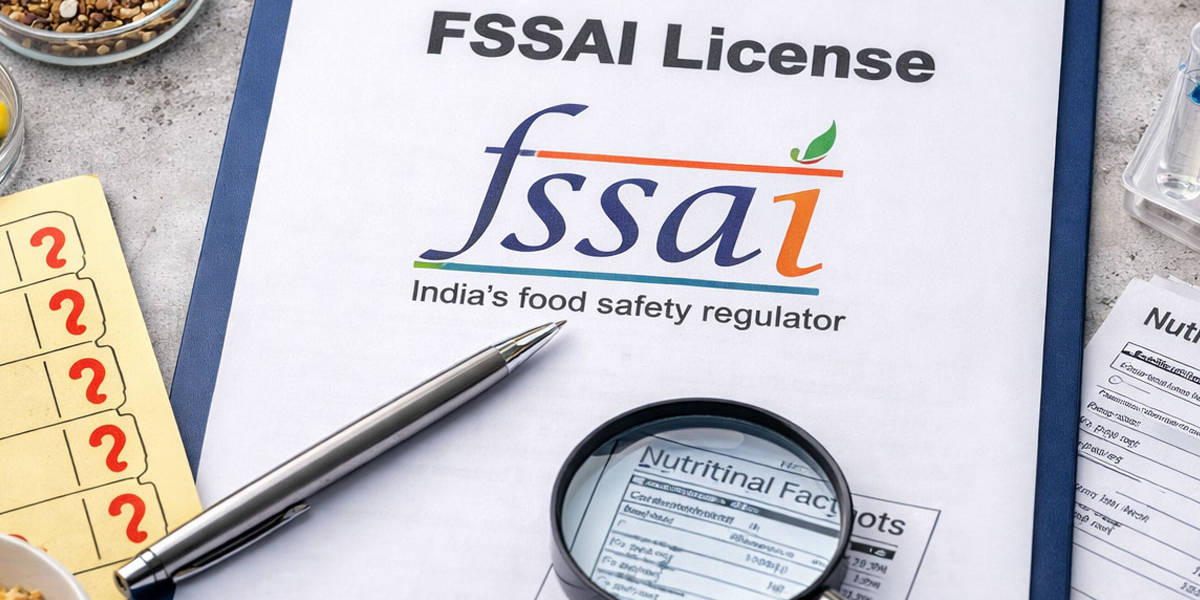

If your business touches food at any point—whether you’re cooking, packing, storing, delivering, or selling it—getting an official FSSAI registration or license is not optional. It is a mandatory legal requirement under Indian law. This applies to everyone across the board, including home bakers, cloud kitchens, local restaurants, packaged snack brands, importers, and large-scale manufacturing facilities. Operating without proper authorization puts your enterprise at risk of heavy financial fines, immediate premises closures, and formal prosecution under the Food Safety and Standards Act, 2006.
This comprehensive guide covers everything you need to know about completing your food business registration in 2026, including the available license tiers, paperwork requirements, a step-by-step walk-through of the online portal, current official fees, and the consequences of ignoring compliance.
What Is FSSAI?

The Food Safety and Standards Authority of India (FSSAI) is an autonomous statutory body created under the Ministry of Health and Family Welfare. Formed under the provisions of the Food Safety and Standards Act, 2006, it serves as the central agency overseeing and regulating food safety standards across the country.
The authority establishes scientific parameters for food products, defines mandatory hygiene and sanitation conditions for food preparation, and mandates that every Food Business Operator (FBO) secure official registration or a license prior to starting operations. This requirement covers all scales of operation, from a neighborhood tea stall to a multinational corporation bringing imported food items into India.
When an application is approved, the business receives a unique 14-digit FSSAI registration or license number. Under food safety rules, this 14-digit number must be clearly printed on all packaged food product labels, displayed on commercial signboards, and mounted prominently inside the main business premises. Displaying this number signals to consumers and regulatory officers that your business complies with the health and safety standards set by the government.
Types of FSSAI Licenses in India

Food safety approvals are divided into three distinct tiers based on the operational scale, business model, and annual revenue of the business:
| License Tier | Annual Turnover Threshold | Validity Options |
|---|---|---|
| Basic Registration | Up to ₹12 Lakhs | 1 to 5 Years |
| State License | ₹12 Lakhs to ₹20 Crores | 1 to 5 Years |
| Central License | Above ₹20 Crores (or Interstate/Import/Export) | 1 to 5 Years |
1. Basic Registration
This entry-level tier is meant for small-scale food enterprises, such as local corner stores, street food vendors, micro-bakeries, and home-based food businesses generating under ₹12 lakhs in total annual revenue. Local municipal health departments handle the issuance of basic registrations.
2. State License
Mid-sized businesses generating between ₹12 lakhs and ₹20 crores annually must apply for a State License. Typical operations under this category include standalone restaurants, regional distributors, food processing plants, commercial storage units, and medium-sized producers operating within a single state boundary.
3. Central License

Large enterprises with annual turnover exceeding ₹20 crores must secure a Central License. In addition, specific business categories require a Central License regardless of their actual revenue:
- Importers and exporters of food products.
- Businesses supplying meals or catering services to central government departments or defense establishments.
- Operators of large-scale central warehouses or cold chain facilities.
- E-commerce platforms and food businesses that maintain physical operations across multiple states.
Understanding the FoSCoS Portal
FoSCoS stands for Food Safety Compliance System. Launched by the government to replace the older Food Licensing and Registration System (FLRS), it serves as the central online platform for all food safety permissions in India.
By logging into the portal at foscos.fssai.gov.in, food business owners can manage all regulatory tasks from a single interface:
- Submit online applications for new basic registrations or licenses.
- File renewal applications and request updates to business details.
- Track the real-time processing status of pending applications.
- Submit mandatory annual returns (Form D).
- Link GSTIN and PAN details for digital identity verification.
The FoSCoS portal eliminates the need for physical visits to government offices. Applications are processed through a structured online workflow, and basic registrations are frequently issued automatically if the uploaded documentation is accurate and complete.
Documents Required for Application

Organizing your supporting documents in advance helps prevent administrative delays. File uploads must be clear, legible, and formatted as PDF, JPEG, or PNG files (typically kept under 1 MB per file).
For Basic Registration
- Passport-size photograph of the primary applicant or proprietor.
- Government-issued photo ID (PAN Card, Voter ID, or official identity proof).
- Proof of business location (recent utility bill, registered rent agreement, or property ownership document).
- Completed Form A application layout.
For State License
- Completed Form B application layout.
- Official business registration certificate (Partnership Deed, Certificate of Incorporation, or Shop and Establishment registration).
- GST Registration Certificate.
- Passport-size photographs of the proprietor, partners, or corporate directors.
- Address proof for the operational business premises.
- Facility layout plan or floor blueprint showing processing zones.
- Itemized list of all food categories and specific products handled.
- List of installed equipment, capacity, and machinery details.
- Certified water testing report from a recognized laboratory (if water is used as an ingredient in processing).
For Central License (Additional Documents)
- Certificate of Incorporation issued by the Ministry of Corporate Affairs (MCA).
- Import Export Code (IEC) issued by the Directorate General of Foreign Trade (DGFT), if applicable.
- Audited financial turnover proof for the preceding financial year.
- Comprehensive Food Safety Management System (FSMS) plan.
- Product recall plan documentation (mandatory for central manufacturing entities).
Step-by-Step Registration Process on FoSCoS


Application Workflow├── Create account on FoSCoS portal├── Select business type & determine license tier├── Fill Form A (Basic) or Form B (State/Central)├── Upload clear document scans├── Pay government fee (1–5 years)└── Download digital certificate upon approval
Step 1: Create an Account
Go to foscos.fssai.gov.in and select “Sign Up.” Fill in your full name, primary mobile number, and email address. Verify your account details using the One-Time Passwords (OTPs) sent to your mobile and email, then set a secure password to complete your account registration.
Step 2: Determine Your Eligibility Tier
Click “Apply for License/Registration” on your main dashboard. Complete the setup questionnaire regarding your business location, operational categories, and anticipated annual revenue. The system will process your responses and identify the required tier: Basic Registration, State License, or Central License.
Step 3: Complete the Online Form
Fill in Form A (for Basic) or Form B (for State or Central). Provide operational details, including your business legal structure, main address, daily production or handling capacities, and the designated food safety manager or contact person.
Step 4: Upload Supporting Documents
Attach legible digital scans of all required documents. Clear document uploads help prevent processing pauses, as unclear or blurry attachments are a primary reason applications are returned for correction.
Step 5: Pay the Government Fee
Select your preferred validity period—from 1 to 5 years—and complete the online payment using net banking, credit/debit card, or UPI.
Step 6: Application Review and License Issuance
After payment verification, the system generates a unique application reference number for tracking.
- Basic Registrations are generally reviewed and issued digitally within 7 to 10 working days without requiring an on-site inspection.
- State and Central Licenses typically take 30 to 60 days to process. Licensing officers may schedule an on-site physical inspection to review physical infrastructure, operational hygiene, water source quality, and sanitation protocols before granting final approval.
Once approved, your official digital certificate can be downloaded directly from your FoSCoS account dashboard.
Government Fee Structure

Official application fees depend on the license tier and the chosen validity period. The annual baseline fees are set as follows:
| License Category | Annual Fee |
|---|---|
| Basic Registration | ₹100 per year |
| State License (Petty Food Manufacturers) | ₹2,000 per year |
| State License (Other Food Establishments) | ₹2,000 to ₹5,000 per year |
| Central License | ₹7,500 per year |
For multi-year applications, the full amount must be paid upfront at the time of submission (for instance, a 5-year Basic Registration costs ₹500 total). All government processing fees are non-refundable once the application enters formal review.
License Renewal Requirements
An FSSAI registration or license is issued for a fixed term of 1 to 5 years. Operating a food business with an expired license is considered equal to operating without one, making timely renewal essential.
- Filing Window: Renewal applications must be submitted online at least 30 to 60 days before the current license expires. The portal accepts renewal submissions up to 120 days prior to the expiration date.
- Renewal Steps: Log into your FoSCoS account, select your existing license record, update any modified operational details, upload required updated documents, and pay the fee for the chosen extension term.
- Penalty Charges: Missing the expiration cutoff results in daily penalty fees for every day the renewal is delayed. If the license fully lapses, operations must cease immediately, and a fresh application must be submitted from the beginning.
Consequences and Penalties for Non-Compliance

The Food Safety and Standards Act, 2006, establishes strict penalties for businesses operating without valid approval or failing to meet health standards:
- Operating Without Approval: Penalties up to ₹5 lakhs along with potential imprisonment for up to 6 months.
- Selling Sub-Standard Food Products: Financial penalties reaching up to ₹5 lakhs.
- Misbranded or Misleading Product Packaging: Fines up to ₹3 lakhs.
- Food Adulteration Violations: Financial penalties ranging from ₹1 lakh to ₹10 lakhs. Severe adulteration cases resulting in bodily harm or death can carry lifetime imprisonment sentences under national law.
In addition to direct financial fines, food safety officers carry legal authority to conduct unannounced premises inspections, impound non-compliant inventory, seal production lines, and order immediate business shutdowns. Furthermore, major e-commerce platforms, meal delivery services, and digital marketplaces require a verified 14-digit FSSAI number before allowing any seller to list food products on their platforms.
Frequently Asked Questions
1. Is an FSSAI license required for home-based food businesses and cloud kitchens?
Yes. Every food business, including home kitchens, home bakers, and cloud kitchens, must hold at least a valid Basic Registration to prepare and sell food legally.
2. Can I apply for my FSSAI license through an offline office?
No. All new license applications, details updates, and renewal filings must be processed digitally through the government’s official FoSCoS online portal.
3. What is the key difference between FSSAI registration and an FSSAI license?
Basic Registration is designed for micro-enterprises and small vendors with an annual turnover under ₹12 lakhs. Larger businesses earning above ₹12 lakhs must obtain a State or Central License depending on their operational area and overall revenue scale.
4. What happens if I forget to renew my FSSAI license before it expires?
Once a license passes its expiration date, it becomes legally invalid. You will incur daily late fees, and if the grace period expires, you must suspend food operations completely and apply for a brand-new license.
5. Where am I legally required to display my 14-digit FSSAI number?
You must print your 14-digit number on all packaged food labels, include it on consumer bills and invoices, and display your physical certificate prominently inside your business premises.




Leave a Reply